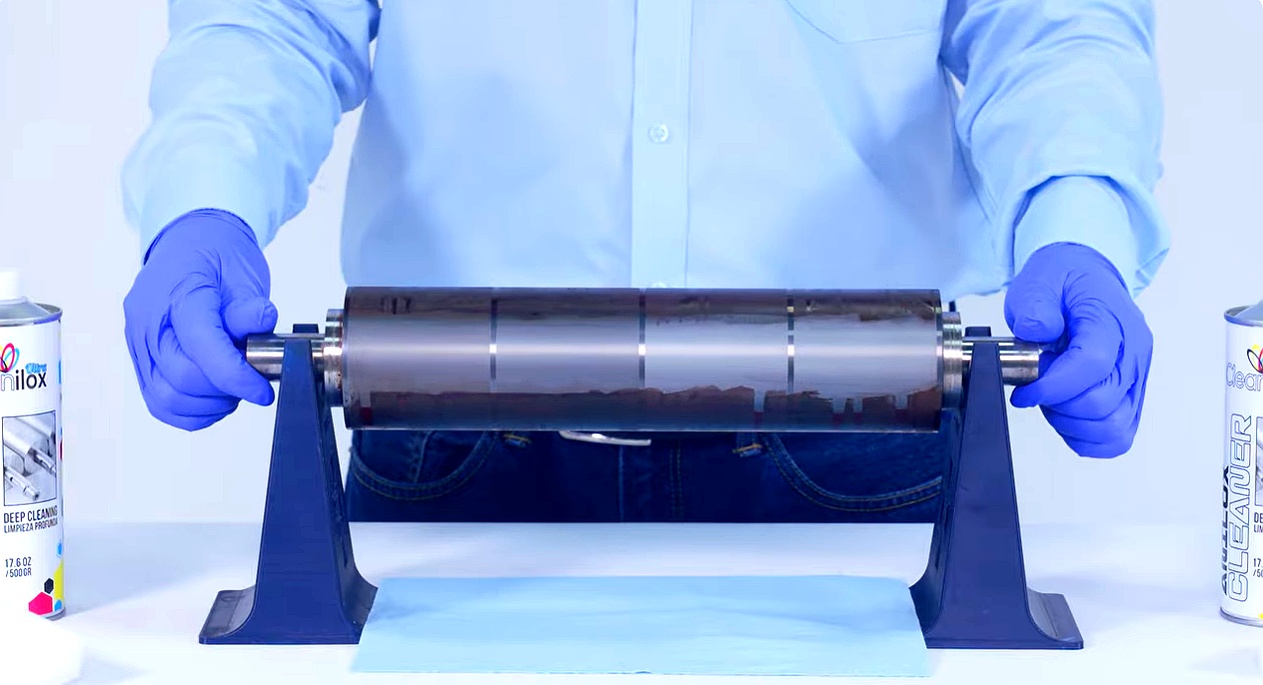
In graphic arts, the printing process reproduces a document several times on various materials. Some methods are more economical than others and follow different processes: offset, lithography, screen printing, flexography, and more.
Flexographic printing is mainly used to produce self-adhesive labels for the food and packaging industries because it delivers quality, speed, and flexibility. It can print on a wide variety of substrates — absorbent and non-absorbent — and uses fast-drying techniques that reduce production times.
How do anilox rollers work?
The primary function of the anilox roller is to meter and deliver wet ink to the surface of the printing plate. The engraving on the anilox establishes and determines ink transfer characteristics and volumetric precision.
Anilox rollers have a chromium oxide coating — popularly known as ceramic — that is critical to their life and performance. Overly porous ceramics produce engravings with volumetric inconsistencies that transfer to the print, causing tonal variations. Ceramics that are too soft or too hard allow instability in the engraving and shorten anilox life.
The most important characteristic for correct performance is cell volume, as the thickness of the ink film determines color tone. Cell design also affects print quality: very deep, narrow cells are prone to clogging, forming dry ink films that adhere to internal surfaces and causing printing errors such as spots or tonal discontinuity.
Why is cleaning important?
Thorough, routine anilox cleaning helps maintain consistent, high-quality print output.
Most color stations on flexographic presses have motors that allow the anilox to rotate independently and lubricate itself with ink when the press is stopped. This minimizes or eliminates the risk of permanent clogging. If the color station must stop entirely, or the roller must be removed from the press, the ink remaining on the ceramic surface must be cleaned immediately, since all the adhesion components in the ink are activated as it dries.
Once ink has dried on the roller, the chance of recovering the original volumetric capacity is low. It is estimated that about 80% of these rollers are discarded before completing their service life due to clogging or mishandling damage. For this reason, proper cleaning is a key factor to extending roller life.
Rollers are commonly damaged by the use of aggressive cleaning chemicals — either acidic or alkaline — to remove dried ink. These tend to destroy the ceramic, creating microfractures in the cell walls and limiting anilox life. It is important to adopt a preventive policy: clean the ink before it dries with a mild cleaner (pH between 4 and 11) that can remove ink while still wet inside the cells. If you wait until it dries, it is practically impossible to clean the cell with this type of product.
It is also recommended to clean in short cycles and rinse parts immediately, since prolonged exposure to cleaners is harmful to the roller.
Recommended cleaning and maintenance procedure
- Prevent the ink from drying.
- If the line must stop, keep the roller constantly wetted and in motion.
- If the roller must be removed, continue with:
- Clean immediately with plenty of water if the ink is water-based.
- Use a suitable product whose pH is neither too high nor too low.
Before using any product, request its Safety Data Sheet (SDS) to ensure it is not harmful, confirm its pH, and understand the necessary precautions.
In summary, the anilox roller is a key piece for flexographic printing. Thanks to the consistency and precision of its microcells, it delivers suitable ink transfer and the desired tone. To make the most of its benefits, you need a preventive care and maintenance policy.
References
Need the right anilox cleaner?
We'll help you select pH-balanced products that protect your investment in ceramic rollers.
Contact Sales